Imagine this.
A student is sitting in the last row of a lecture hall, laptop open, half listening, half worrying. Graduation is six months away. Job market feels uncertain. Loan statements already look scary.
Now here’s the twist.
Before this student even tosses the graduation cap, AI already knows the chances of loan default.
Not guesses. Not assumptions.
Predictions. With data.
Sounds unsettling, right?
Also… incredibly powerful.
Artificial Intelligence is quietly changing how lenders, universities, and even governments look at student loan risk — before students leave campus. And almost nobody is talking about it.
Let’s break it down.
What Does “Student Loan Default Risk” Really Mean?
Student loan default risk simply means the probability that a borrower will fail to repay their loan on time — usually within the first few years after graduation.
Traditionally, lenders waited until things went wrong. Missed EMIs. Late payments. Collections.
But AI flips this logic.
Instead of reacting, AI predicts risk early, sometimes as early as the second year of college.
Pause.
That changes everything.
How AI Predicts Loan Default Before Graduation
AI systems don’t rely on a single factor like grades or family income. They analyze patterns, thousands of them, at once.
Here’s what modern AI models typically analyze:
- Academic consistency (not just GPA, but trend)
- Course difficulty vs performance
- Attendance behavior
- Internship history
- Part-time work stability
- Spending habits (where legally allowed)
- Loan size vs expected salary
- Field of study market volatility
- Behavioral signals (missed deadlines, digital engagement)
None of these alone mean default.
But together? They tell a story.
A predictive story.

The AI Models Behind These Predictions (In Simple Words)
No heavy math here. Promise.
Most student loan risk systems use a mix of:
1. Machine Learning Classification Models
These models learn from past borrowers — who paid, who defaulted, and why.
2. Predictive Analytics
AI looks at future outcomes based on historical patterns.
For example:
“Students with this behavior pattern had a 27% higher chance of missing payments in year one.”
3. Behavioral AI
This is the newer part.
It tracks behavioral consistency, not intelligence.
Skipping forms. Late submissions. Ignoring reminders.
Small signals. Big meaning.
Why Traditional Loan Risk Models Are Falling Apart
Old systems relied on just a few inputs:
- Family income
- Credit history (often none for students)
- Institution ranking
That’s it.
But student realities have changed.
Gig work. Hybrid careers. Delayed employment. Mental burnout.
Traditional models are blind to these shifts.
AI isn’t.
AI vs Traditional Loan Risk Assessment (Comparison Table)
| Factor | Traditional Models | AI-Driven Prediction |
|---|---|---|
| Timing of Risk Detection | After missed payments | Before graduation |
| Data Points Used | 3–5 static factors | 1000+ dynamic signals |
| Adaptability | Fixed rules | Self-learning models |
| Student Behavior Tracking | None | Continuous |
| Personalization | Same rules for all | Individual risk profiles |
| Accuracy Over Time | Declines | Improves with data |
This gap explains why lenders are moving fast — quietly.
Who Is Using This AI Right Now?
Not just banks.
- Private student loan providers
- EdTech platforms
- Universities (early intervention systems)
- Government-backed loan agencies
- Fintech startups
Some use it to reduce losses.
Others? To help students avoid default before it happens.
Important distinction.
Is This Good or Bad for Students?
Honestly?
Both.
The Good Side
- Early support for at-risk students
- Personalized repayment planning
- Lower interest rates for low-risk profiles
- Financial counseling before graduation
- Reduced long-term debt stress
The Concerning Side
- Privacy worries
- Algorithmic bias
- Labeling students “high risk” too early
- Decisions made without human context
And yes…
AI can be wrong.
How Accurate Are These Predictions Really?
Short answer: surprisingly accurate.
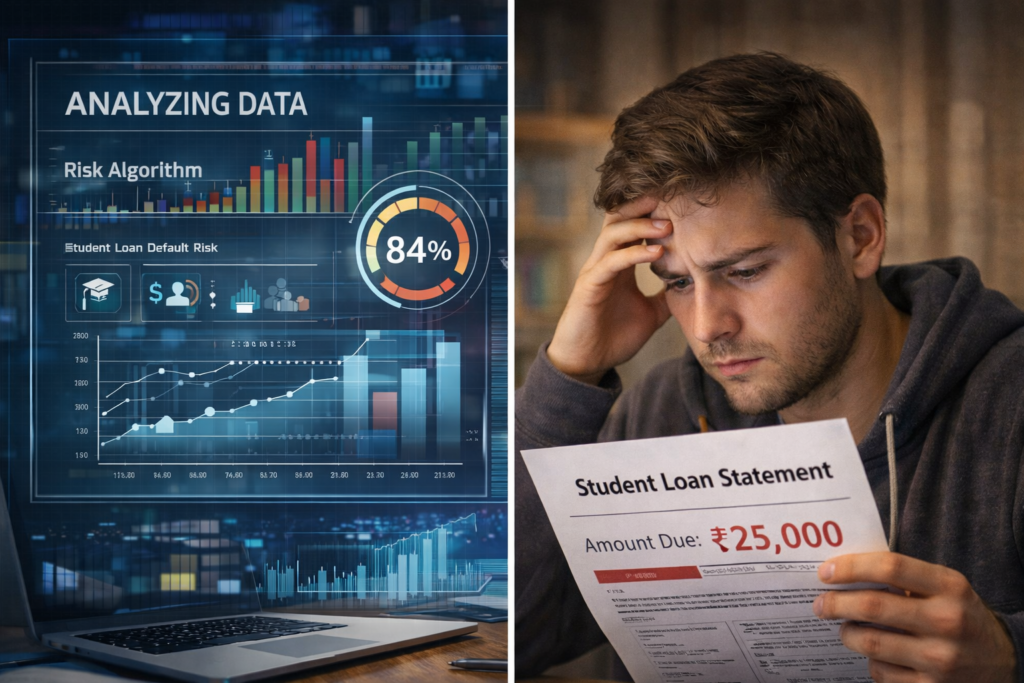
Modern AI models can predict student loan default with 70–85% accuracy, depending on data quality.
But accuracy isn’t the real magic.
The real power lies in early warnings.
AI doesn’t say:
“You will fail.”
It says:
“Your current path increases risk. Adjust now.”
That difference matters.
Can AI Actually Prevent Student Loan Defaults?
Yes. And it already is.
Here’s how:
- AI flags high-risk students early
- Universities offer financial literacy support
- Lenders restructure repayment terms
- Students receive personalized guidance
- Career counseling is adjusted proactively
Default prevention becomes intervention, not punishment.
That’s new.
Ethical Questions Nobody Likes to Ask
Let’s not ignore this.
- Should AI judge a student’s future?
- Who owns the prediction data?
- Can students challenge AI scores?
- What about bias against certain fields or backgrounds?
These questions don’t have clean answers yet.
But ignoring them would be worse.
What This Means for Future Students
If you’re a student reading this:
Your financial behavior during college matters more than ever.
Not just grades.
Not just income.
Consistency. Awareness. Planning.
AI is watching patterns — not judging personalities.
What This Means for Parents and Educators
Early conversations help.
Financial literacy isn’t optional anymore.
Neither is transparency.
The earlier students understand loans, the safer their future becomes.
The Quiet Future of Student Lending
Here’s the truth most blogs won’t say:
AI will soon know who needs help before they ask for it.
And that can be either terrifying…
or life-saving.
Depends on how it’s used.
Final Thoughts (A Small Pause)
Student loans were never just numbers.
They’re choices. Pressure. Hope. Fear.
AI doesn’t replace human judgment.
But it reshapes timing.
Earlier insights. Earlier help. Earlier control.
And maybe, just maybe, fewer students sitting in the back row…
wondering how it all went wrong.